
21st February 2011
F&C: The next asset class bubble

The next asset class bubble?
Introduction
An asset bubble is formed when the price deviates from its intrinsic valuation and speculation takes over from fundamental analysis. Buyers of the asset purchase it on the basis that they hope to resell it late at a higher price and not because they think it represents good value. This is the greater fool theory of investing that characterises all bubbles.
There was talk that some bond markets had become bubbles last year as yields on safe haven bonds fell sharply. However, this was, I believe, merely a phase of over-valuation partly as a result of technical factors that drove institutions to buy bonds in favour of more risky asset classes. The subsequent rise in bond yields has quickly reversed the fall in the second half of last year as the risk on trade has returned. The last major bubble was the collapse of the housing market in the US, that was mirrored in some European countries such as Ireland and Spain, and which led directly to the biggest global recession since the Great Depression of the 1930's.
Recent bubbles
'The Big Short' by Michael Lewis describes the use of arcane financial products on sub prime mortgage loans in the US that was the manifestation of the real estate bubble that sparked the financial crisis by triggering the derivative products (generally complex forms of CDS) held by major institutions. What is amazing is that the people, who were very few in number, who were convinced that there was a bubble in the US housing market did not just think it was possible but were certain of it. One eccentric, but very successful hedge fund manager Mike Burry, an investing genius, wanted to find a way to bet against the housing market as early as 2004 but no CDS product existed for sub prime mortgages. He called all the major institutions and almost none understood what he was talking about when he suggested buying CDS insurance against sub prime mortgages. Only Deutsche Bank and Goldman Sachs took him up on it and subsequently they could not sell him enough. Clearly the major banks did not regard it as a major risk but some straightforward analysis showed that not only would there be major defaults if house prices fell but even if they started to go up at a slower rate!
The bubble that most of us are more familiar with as security market practitioners is the dot com bubble of the late 1990's that burst in 2000. As the valuations soared to stratospheric levels, so new valuation methods were created to justify the vertiginous prices paid. Dividend payments were a sign of corporate weakness and PE multiples were jettisoned in favour of long term DCF models where the assumptions could be tweaked to produce flattering present value calculations.
Following two such spectacular bubbles in the recent past, investors are eagerly searching for the next. This is not just to preserve existing capital but, as Mike Burry proved, a spectacular amount of money can be made by betting against it. So where is it going to be?
Not Emerging Markets (EM) or commodities
The most frequently mentioned candidates for the next bubble are emerging markets (EM) and commodities and, of course, the two are closely related. Emerging market growth is a secular phenomenon, led by China, and will continue for at least another generation as they converge with developed economies. It is reckoned China is at a similar stage in its development to the US as Japan was in 1950 with an average income per capita of just 20% of the US. Between 1950 and 1970, Japan caught the US up although it has subsequently slipped back again. I doubt that China will undergo such a rapid transformation given it is a much more agrarian country with a vast population but the trend is set in stone. Other emerging markets are undergoing a similar change and their rapid growth relative to western countries is set to continue for many years.
To participate in EM growth there has been substantial investment flows into both EM debt and equity markets. However, given the longer term prospects for these economies when compared to developed markets (DM) their assets are a long way from representing a bubble. The valuations of EM equities have converged with DM but are, on average, at a slight discount and EM debt, while appearing more expensive, has much superior coupons and is arguably of a superior covenant with the low levels of public debt compared to their western counterparts.
Commodities are a more likely candidate for the next bubble, especially soft commodities (see the chart below of recent moves in some soft commodities).
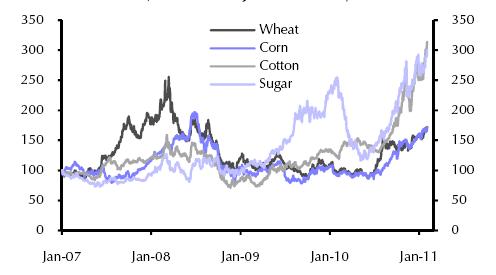
The relatively recent trend to financial investment in various forms of commodities via trading mechanisms such as ETFs has led to more volatility as investors seek to take advantage of swings in sentiment, demand and supply. This means that periods of excessive over and under-valuation have and will become more frequent. The secular growth of EM means that the surge in commodity prices since 1999 is to a large extent justified. Crucially, compared to most other assets that have been subject to bubbles, there is a limited supply of both hard and soft commodities many of which are subject to unpredictable events such as extreme climate. This means that the bull market in commodities is likely to continue in tandem with the growth in EM, albeit with severe corrections in the meantime. In the longer term, commodities will remain a poor investment as they only produce a capital return and vulnerable to swings in demand and supply as well being subject to becoming obsolete or to substitution. They are also expensive to store and transport.
The next bubble
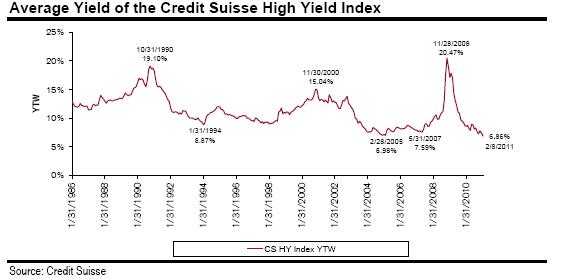
In the absence of EM or commodities forming the next bubble, I believe it is likely to come from an asset that can provide a 'secure' yield in what is a low yield environment. With inflation rising on a global basis the returns on many assets in the form of interest payments or dividends is often negative. Investors are desperate to achieve a real return on their capital while limiting the risk and this partly explains why EM debt has done so well and now appears dearer than EM equities. The next candidate for the bubble is, therefore, in sub investment grade and junk bonds where issuance is already rising rapidly. Corporate failures have fallen sharply as economies have made a tentative recovery in the western world allowing companies to issue debt to hungry investors. In the last 7 months, $20bn or more has been raised each month, and as a result the yield on low grade corporate bonds has come rattling down to below 7%, the first time for 6 years. Look at the chart below on a bespoke index from Credit Suisse and following the recent surge the yield has hit an all time low.
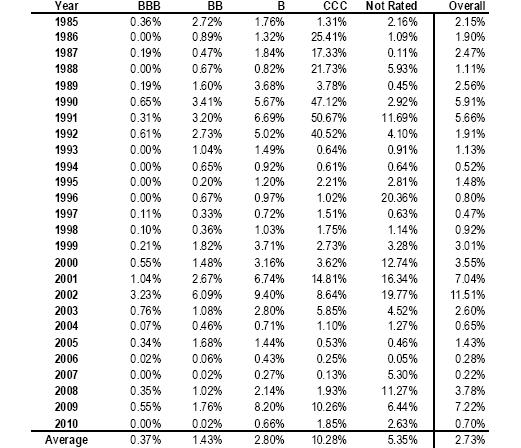
Whether a bubble occurs depends on the trend in default rates that have sunk to a recent low. The table below shows the default rate for various categories of bonds and it is evident that current default rates are significantly below the average since 1985. Default rates are so low reflecting the relative financial strength of the corporate sector compared to local and central governments and private individuals. It has also been helped by the unprecedented monetary and fiscal stimulus since the financial crisis broke in 2008. These are both due to expire and it is probable that interest rates will also be raised in 2011. I believe the US recovery is very fragile with the continuing high levels of debt and unemployment as well as a weak housing market making further corporate recovery harder to attain. For corporate bonds this poses a substantial risk at a time when the yields are at an historic low and issuance is booming.
Bubbles usually occur in areas where it is accepted wisdom that 'it is different this time' to use the hackneyed phrase. Furthermore, the latter stages of the bubble when euphoria takes over and no investment valuation yardsticks make any sense act as warnings but also attract the fastest and greatest gains (and subsequent losses). We are a long way from that but such behavioural traits that characterise all bubbles should be borne in mind when considering whether or not a bubble has occurred. The trend in high yield and junk bonds should be monitored closely.
Ted Scott, Director, Global Strategy
February 2011
Not yet registered?
Please complete this form to join our community